When technology outpaces the capital cycle.
Who captures the savings from useful computing, and who remains liable for the capital already committed?
Six pages · English · Adapted from the dated sector research
The same revenue dollar passes through several businesses.
An end customer pays for useful work. The service provider buys compute; the cloud provider buys systems, power and facilities.
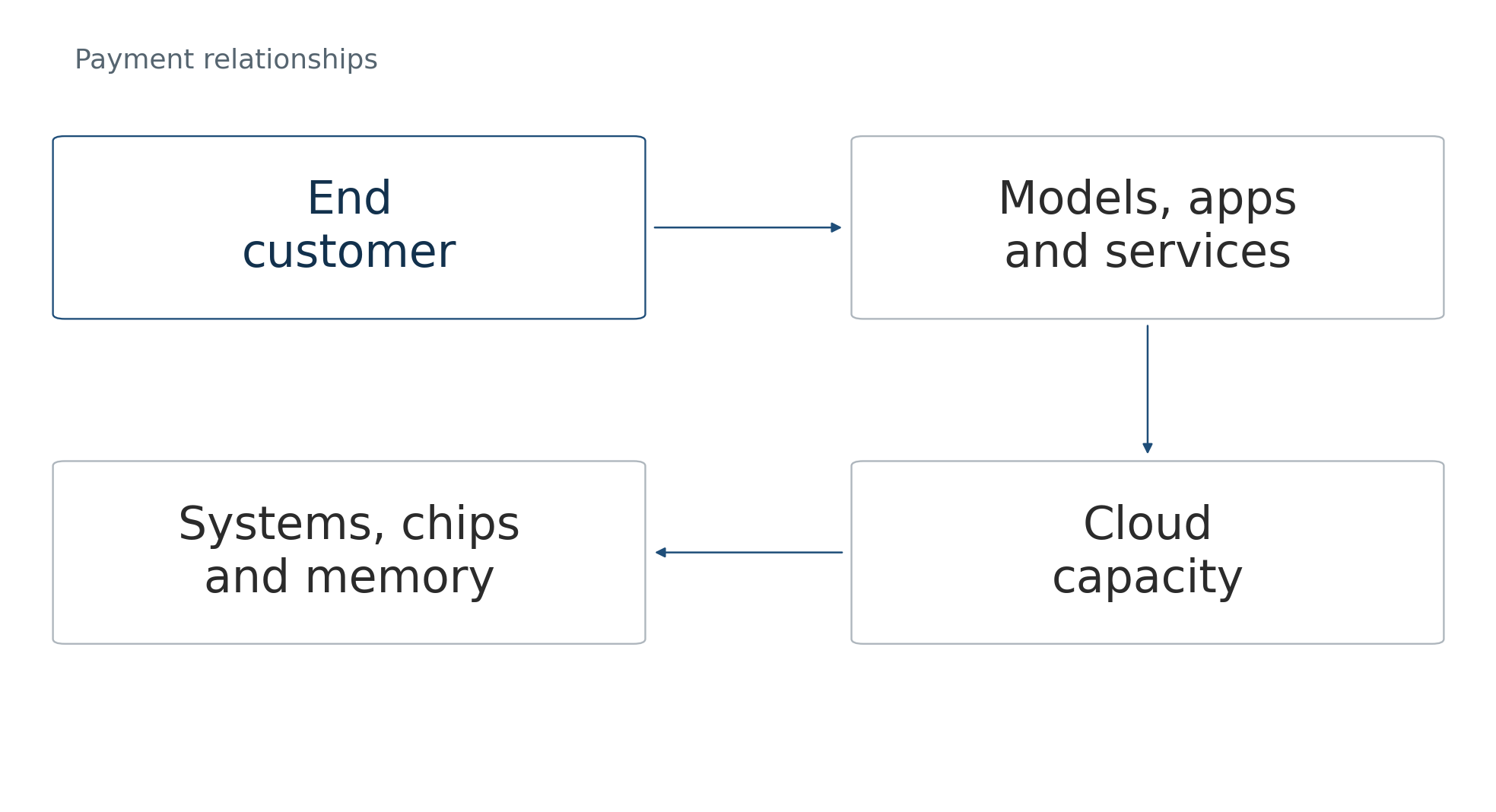
Revenue at several stages does not create several independent sources of final demand.
One efficiency gain can become a lower customer bill, a higher service margin, more usage or fewer future equipment purchases. It cannot be counted in full at every stage.
Sector Strategy, pp. 4-7 and 17. Diagram is an analytical simplification.
A supplier can be paid before its customer earns a return.
A system sale can precede commissioning, paid utilisation and recovery of the buyer's investment. A delay leaves less time to earn back capital before the next upgrade.
Existing contracts can sustain deliveries even while future investment becomes less attractive.
The question is whether the next phase is flexible enough to wait, change architecture or avoid spending before demand is proved.
Announced capacity is not operating capacity.
Sector Strategy, pp. 9-10. Primary context [P1]: linked cloud and hardware commitments. The cash-return interpretation is the author's.
A shorter earning life raises the replacement burden.
Hold fleet size and replacement prices constant. Assume zero residual value and steady renewal.
+50% annual replacement. Per 100 of fleet cost; illustration, not a company forecast.
More frequent renewal consumes more cash before distributions to owners. This is a recurring maintenance illustration, not a one-off construction budget.
The concern weakens if older equipment keeps earning positive cash margins, or cheaper replacement offsets faster renewal.
Illustration, not a GPU-life forecast or a valuation haircut.
Sector Strategy, p. 9 and Figure 6, p. 10; sector-workbook illustration dated 5 Nov 2026. Assumptions are not measured industry forecasts.
The efficiency winner depends on who retains the saving.
NVIDIA / Broadcom. Customer adoption and design wins must translate into durable equipment demand and margins.
Microsoft / Amazon / Alphabet. Lower computing costs must survive customer discounts and cover commissioning, financing and renewal.
Anthropic. More usage must produce enough cash margin to meet capacity commitments.
AWS and NVIDIA publish efficiency claims for different systems and workloads. Those claims are not a common industry price benchmark.
Reported cloud growth is a starting point; the cash return on the installed fleet remains a separate test.
Sector Strategy, pp. 7, 13 and 15-17. Primary context [P2-P4]; efficiency statements remain supplier claims. These are research questions, not stock calls.
Which capacity commitments can earn back their cost before renewal?
A focused mandate can test one company, one investment programme or a defined group of suppliers.
Trace the evidence. Separate customer receipts, supplier payments and financing.
Test the economics. Reconcile commissioning, utilisation, pricing, replacement and claims on cash.
Define the decision. Identify the driver, the observation that could overturn the thesis, and its model sensitivity.
Selected primary context
[P1] Anthropic | Microsoft-NVIDIA partnerships | 18 Nov 2025
[P2] AWS | Trn2 product specifications
Based on Sector Strategy, pp. 22-25. Scope, timing, deliverables and commercial terms are agreed for each mandate. New research and updates are scoped separately.